Showing posts with label mid-cap. Show all posts

Monday, June 18, 2012

The 10% FCF yield club

When a company's business is easy to understand, offers a 10% FCF yield, provides steady and predictable profit year-in-year-out without oversize Capex, I get excited. If it can grow its cash flow in line with nominal GDP growth, it can easily offer 15% p.a. return. 15% has been Buffett's hurdle rate throughout his investing life. This is the "good enough" mentality that both Warren Buffett and Ben Graham advocate. If it's good enough for Buffett, it should be good enough for me.

What's interesting here though is I started looking at one company which led my thoughts onto another company which led me onto another one... And I ended up indecisive....

Let's start with Lamar Advertising.

Lamar Advertising
  • Company: Lamar Advertising (NASDAQ:LAMR)
  • Market Cap: $2.55B
  • TTM FCF yield: 9%
  • Business: The 3rd largest billboard advertising provider in US
  • Moats: Nothing can replace billboards for brand-awareness advertising. Highway Beautification Act (1965) limits the number of billboards that can be built. This is pretty close to Buffett's "toll booth" type of business.
  • Positives: A gradual recovering US economy will improve both occupany and rates. LAMR will also be able to refinance some of its debts in the coming years with lower interest rates.
  • Negatives: Cyclical business. Very high debt. FCF interest cover is only 2.2x. But the mgmt has been prudently using all of the FCF to pay down its debts in the last 3 years. Yet, there is no gaurantee the mgmt won't do another debt-fueled acquisition in the future.
My biggest hesitation here is the 2.2x interest cover. It is quite a stretch on my comfort level. While LAMR's cashflow was pretty stable through the GFC, considered that its advertising contracts are typically less than a year long, I'm not sure how much shock such a highly levered balance sheet can take. My issue here is safety.

While I was thinking about LAMR's advertising business, I remembered another advertising related company.

Omnicom Group
  • Company: Omnicom Group (NASDAQ:OMC)
  • Market Cap: $13.2B
  • TTM FCF yield: 10%
  • Business: Advertising agent
  • Moats: Ad agent is a service business.When marketing campaigns get more and more complicated, the value of an Ad agent increases. Its moat resides in its sticky customer relationship. (e.g. Apple has been staying with one agent since Jobs returned. You can't say that for its semi suppliers. Btw, Apple's ad agent belongs to OMC.)
  • Positives: Although debt/equity is ~1.0, interest cover is a comfortable 10x. 
  • Negatives: This is cyclical business and profit moves in tandem with the economy. OMC has significant exposure in Europe. This is both a plus and minus. When Europe's problems fade, we shall see growth. But it may take years.
Next, I remembered Dun & Bradstreet Corp, which was beaten down badly in May after it released its disappointing FY2012 guidance.


Dun & Bradstreet Corp
  • Company: Dun & Bradstreet (NYSE:DNB)
  • Market Cap: $3.22B
  • TTM FCF yield: 8.75%
  • Business: Data provider of business records and credit history
  • Moats: When the database you provide is essential to other people to conduct their businesses and when its size gets to a certain critical mass, its economics benefits from a form of network effect and becomes self-sustainable. This is the kind of business an idiot can run.
  • Positives: But DNB's mgmt are not idiots. They don't chase unattractive growth for the sake of it. They return cash back to investors in the form of share buybacks.
  • Negatives: Business isn't growing in the recent years. Can it really grow in line with the economy?
At this point, I asked myself, why all these troubles? Why don't I just add more to my existing Microsoft position?

Microsoft Corp
  • Company: Microsoft Corp (NASDAQ:MSFT)
  • Market Cap: $252B
  • TTM FCF yield: 11%
  • Business: software
  • Moats: MSFT has 2 undeniable franchises: Windows and Office. Both are essentially annuity kind of business.
  • Positives: Truck load of cash. ROE in the range of 40% without using debt. Growing steadily 8-12% p.a. over many years. On the corporate front, Windows 7 upgrade cycle will accelerate in these 2 years. On the consumer front, Windows 8 sales will provide additional revenues.
  • Negatives: Given its size, growing will become harder and harder. Cloud-based computing and mobile computing both threaten MSFT's franchises. There is also the risk the mgmt will destroy value on poor acquisitions.
I'm pretty comfortable MSFT can defend its turf. It may even be able to leverage its dominance into offering more cloud-based solutions and mobile solutions than everyone can imagine.

No matter how I cut it, MSFT looks like a superior investment to the rest. My conviction is high.

Charlie Munger always says diversification is diworsification. My dilemma here is whether I should diversify in order to reduce my exposure to one single company. No matter how high my conviction is, there are always "unknown unknowns". There is also this unhelpful thought urging me to divest: "Earning outstanding returns requires hardwork. If I keep on adding to just the same old position and not spending time to dig deep into other companies, I'm not working hard enough." (I haven't yet done in depth analyses of some of these other companies. If I end up staying with MSFT, this won't be the best use of my brain power and time.)

I'm really interested in your thoughts!

 (Disclosure: Long MSFT)

Friday, March 16, 2012

Corning: the (Gorilla) Glass company - $GLW

(I did this analysis a few months ago. The price has been volatile but ends up not much higher than where it was. While my view has altered slightly since they released their November quarter numbers, the main thesis is intact. I'll give an update towards the end of post.)

GLW (NYSE)

Chances are you have some Corning ceramic cookware at home. And chances are you have LCD TVs, smart phones and laptops. And chances are you don't know the same Corning making the cookware is the same company which commands 50% of the world market of the glass substrates used in LCD/LED panels.


Valuation

Corning (GLW) consists of 3 main business entities:
  • The parent company Corning: 
    • involves in LCD panel, Environmental (car exhaust converter), optical fibre in telecom, Life Science (e.g Pyrex) and the most sexy Gorilla Glass (the tough glass used on Android phones).
    • In dot.com days, it nearly went bankrupt because of over expanding in fibre optics.
  • Dow Corning: 
    • 50% non-controlling join venture with Dow Chemical. Make silicon products. 
    • It went bankrupt in 1995 because of law suit on its silicon breast implants
  • Samsung Corning Precision (SCP):
    • 50% non-controlling join venture with Samsung.
    • It makes LCD glasses
GLW accounts SCP using the equity accounting method. A great deal of SCP's operation/financial details are not visible in GLW's own financial statements. GLW does include SCP's book in its 10-K's. You just need to look for it.

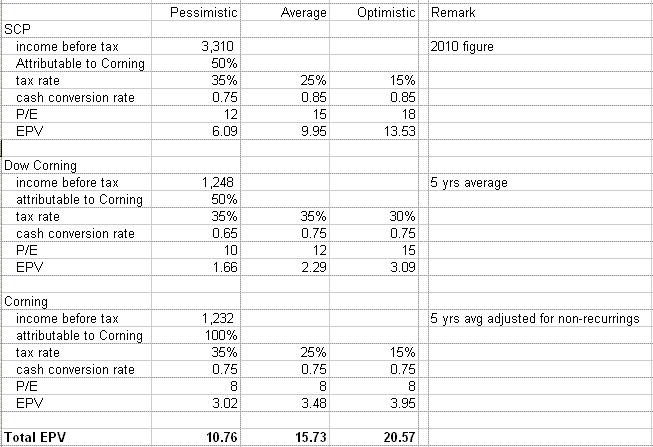
I believe the best way to value GLW is to do a sum-of-parts valuation of its 3 business entities:

(figures in millions)

Here are a few observations worth mentioning:
  • The income before tax figures are normalised, baised towards more conservative figures. See details below.
  • SCP which makes the glass panels for LCD screens is the actual gem. So, it should command a higher multiple. And since its earning and revenue grow consistent over the years, I use its 2010's earning figure instead of multi-year average when I calculate its normalised EPV.
  • Tax rate is a key factor. SCP's foreign earning is on average taxed at only 15%. But after capex, the cash needs to be brought onshore in order to realise the value and will incur tax liability. 
  • Corning is sitting on some $3B worth of deferred tax credit.
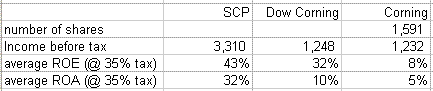
  • Capex is huge across all 3 entities. They are 2-4x average depreciation. There is no way to work out which portion is maintenance capex and which portion is growth capex. (When a factory is retooled to make Gen10 LCD glass panel instead of Gen8, that's as much maintenance -- maintaining profitability -- as growth.) Again, SCP looks best here as its ROA over the years stays pretty consistent. That implies it can maintain its incremental ROE. On the other hand, Dow Corning itself has bumpy ROA. Anyway, I factor in a "cash conversion rate", basically a FCF/accrual earning factor, to cater for the capex.
  • Interestingly, Dow Corning has relatively high ROE. It is achieved with gearing, but it's not debt. Instead, it has customer pre-paid deposit sitting on the book. That's interest free loan from the customers.
  • GLW is also low in debt and has truckload of cash on its book. (50% of its cash are offshore.)

Refer to the table above of the 3 different scenarios. So here we have a range of earning-based valuation between $10-20. (EPV = earning power value)

A quality business

On the qualitative side, without doubt, the world will have more flat panels and touch screens in 10 years time. This is high margin business (gross margin ~60%). GLW currently commands 50% of the worldwide market share. There are a couple Japanese competitors which have comparable technologies. Can GLW maintain its profitability? Apart from the its proprietary know-hows and patents, both supply-chain management and scale matter in this business. It appears GLW excels in both. Its cash conversion cycles are pretty consistent even through the 2008 recession.

GLW is a Buffett/Fisher kind of business. It spends 10%+ on R&D.


I reckon my valuation is conservative. I haven't factored in the huge growing potential of Gorilla Glass and GLW's environmental products in Europe, both have no material contribution to GLW's bottom-line at the moment. And I discount heavily of the growth potential from its capex. I read other analysts gave it a target price of ~$25. It's aggressive but achievable.

Talking about Gorilla Glass. Gorilla Glass is currently used on smart phones. Since GLW sells glass by sq metres, it needs to sell a lot of them to move the needle. The bright future comes from the next generation of LCD/LED TVs which will have full glass cover edge-to-edge for pure aesthetic reason. We know Steve Jobs loves glasses. (Just look at the Apple Stores.) Apple TV is around the corner.

Limited Downside

Wait, there is more.

In the height of GFC in Nov 2008 when a few of GLW's insiders (including the CFO) bought the shares, the price was at around $10. At the time, GLW's book value was $8.50. They were paying 1.25x book value. First forward to Aug 2011. The CFO bought at $13.50. (A much smaller stake. Granted.) Guess what the book value was? It was $13.40. The book value hasn't change much since then. We are now paying ~1.0x book value. Besides, in October last year, GLW instituted share buyback. That instantly put a floor on the share price.

We are talking about a company with ROE in the range of 17-25%, not under any business threat, with low debt and with many future potentials. It's nonsense it's trading at 1.0x book value.

* * *

Update 

I was wrong that GLW wasn't under any business threat.

It was revealed in the fourth quarter a "big customer" walked away from their contract. Although no name was given, it has been reported elsewhere LG had been working with a German company in partnership to produce LCD glasses. In the conference call, GLW management said there would be a "reset in the margins" in the industry, whatever it means.

The LCD glass market has been an oligopoly. Profitability is maintained when the players don't get into a price war in order to grab market share. That's the win-win situation. The risk here is the LG venture tries to fight for market share at any cost and flood the market with supplies. That doesn't just put pressure on the margins. It'll destroy the industry.


Where does this leave us?

I think this doesn't change the main value proposition. However, it does increase the risk.


(Long GLW)